Albania Road-Trip Guide 2026 — Coast, Castles & the Alps
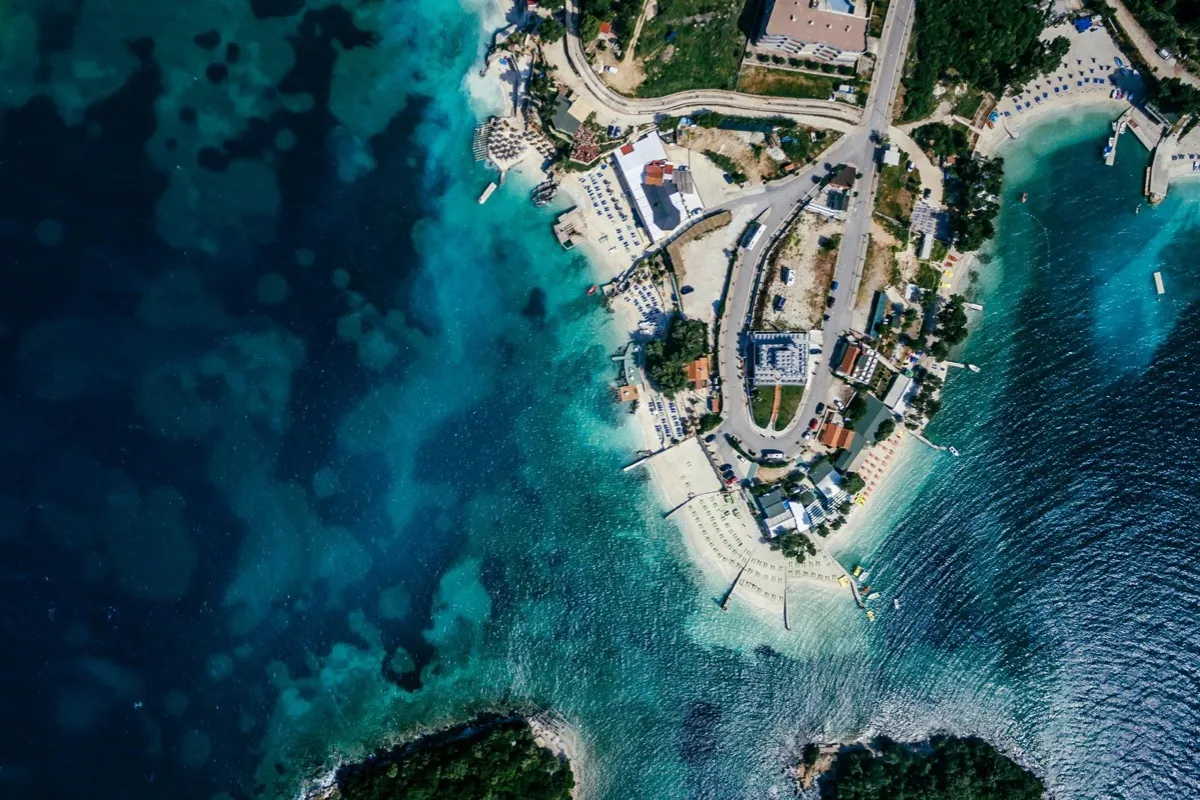
Your keys to the Adriatic & Ionian — turquoise bays, stone cities and mountain passes, all within a single tank of fuel.
In one week you can swim in glass-clear bays at breakfast and stand on a thousand-metre mountain pass by sunset. Albania is compact, the roads are better than its reputation, and the finest places are rarely the ones on the postcard.
This is the route we would take ourselves — written by the people who hand you the keys. Drive slowly, stop often, and talk to everyone.
The guide below covers the classic Coast-and-Castles loop, the Albanian Alps, the food worth searching for, and a no-nonsense briefing on driving here.
Seven Days: Coast & Castles
A relaxed loop of roughly 900 km that strings together the south's best in a week — and reverses fine in the other direction. Day 1 in Tirana means café-lined Blloku, Skanderbeg Square, the cold-war tunnels of Bunk'Art, and the Dajti cable car for the view. Day 2 climbs to Berat, the "city of a thousand windows", where Ottoman houses stack up the hill to a castle people still live inside.
Day 3 reaches Gjirokastër, a UNESCO "stone city" of slate roofs and an enormous fortress — with a swim at the electric-blue spring of Syri i Kaltër on the way. Day 4 is the southern flourish: Butrint's lagoon-forest ruins by morning, the islets of Ksamil and bath-warm water by afternoon. Day 5 is the Riviera proper — Himara's coves, white-pebble Dhërmi, the hike down to hidden Gjipe beach.
Day 6 is Albania's most beautiful drive: the Llogara Pass, hairpins dropping from pine forest straight to the sea, with spit-roast lamb at the top. Day 7 loops home via the ruins of Apollonia or a last espresso on the Durrës waterfront. Add two or three days for the Albanian Alps if you have them — Shkodër → Theth → Valbona — the alpine meadows alone are worth the detour.
The Ionian Riviera
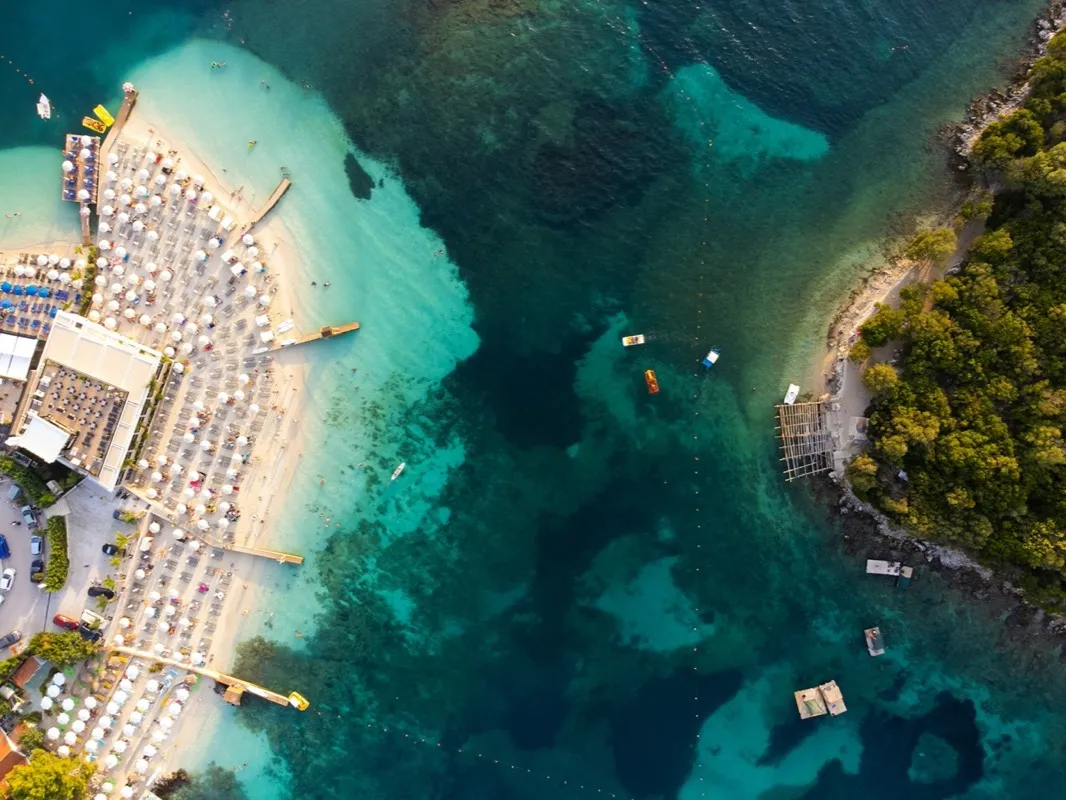
Where the mountains drop straight into water clear enough to read a map through. The Albanian Riviera is roughly 100 km of pebble coves, three little islands at Ksamil, and beach bars that close only when the last guest leaves. The road that strings it together — the SH8 — is one of the great coastal drives of Europe; allow a full day for what looks like a short hop on the map, because every cove is a reason to stop.
Ksamil sits at the south, three tiny islands you can swim to in bath-warm water — the jewel of the Ionian. North of it, Sarandë is the lively base of the Riviera, with ferries to Corfu just across the water. Climb back into the hills and you reach Himara, then white-pebble Dhërmi, then Gjipe Beach: a canyon-backed cove reached on foot or by boat, no shops, no cars — bring water and stay for sunset.
Above it all, the Llogara Pass crosses a thousand metres of switchbacks dropping from pine forest straight to the sea. Stop at the top for roadside spit-roast lamb and an eagle's-eye view over the coast you just drove. May–June and September–October are the sweet spot: warm water, no crowds. July and August are gorgeous but busy — book your car early.
Sun, Sea & Ancient Stone — the Southern Highlights
Past the obvious beaches there are layers most visitors miss. Butrint — a UNESCO site where Greek, Roman and Venetian ruins stack 2,500 years deep inside a quiet lagoon forest — is best at the hour before closing, when the light gets long and the tour buses are gone. Syri i Kaltër, the Blue Eye, is a bottomless spring of impossible blue ringed by forest; the water never stops bubbling up, and the colour shifts as the day moves.
Gjipe Beach asks for a walk in or a boat from Dhërmi. There is nothing there beyond a single small bar and a canyon behind you. That is the point. Bring water, swim, stay for the sun going down behind the headland, and walk back by torchlight. Llogara Pass is the connector between the Riviera and Vlorë; if you only drive one mountain road in Albania, drive this one.
Sarandë is the practical base for the south — ferries to Corfu, abundant restaurants, easy parking outside the centre. Ksamil makes the better swim base if you want to be in the water by 9 a.m. Whichever you pick, pickups from either coastal town save you the four-hour drive back to Tirana on the last morning.
The Albanian Alps
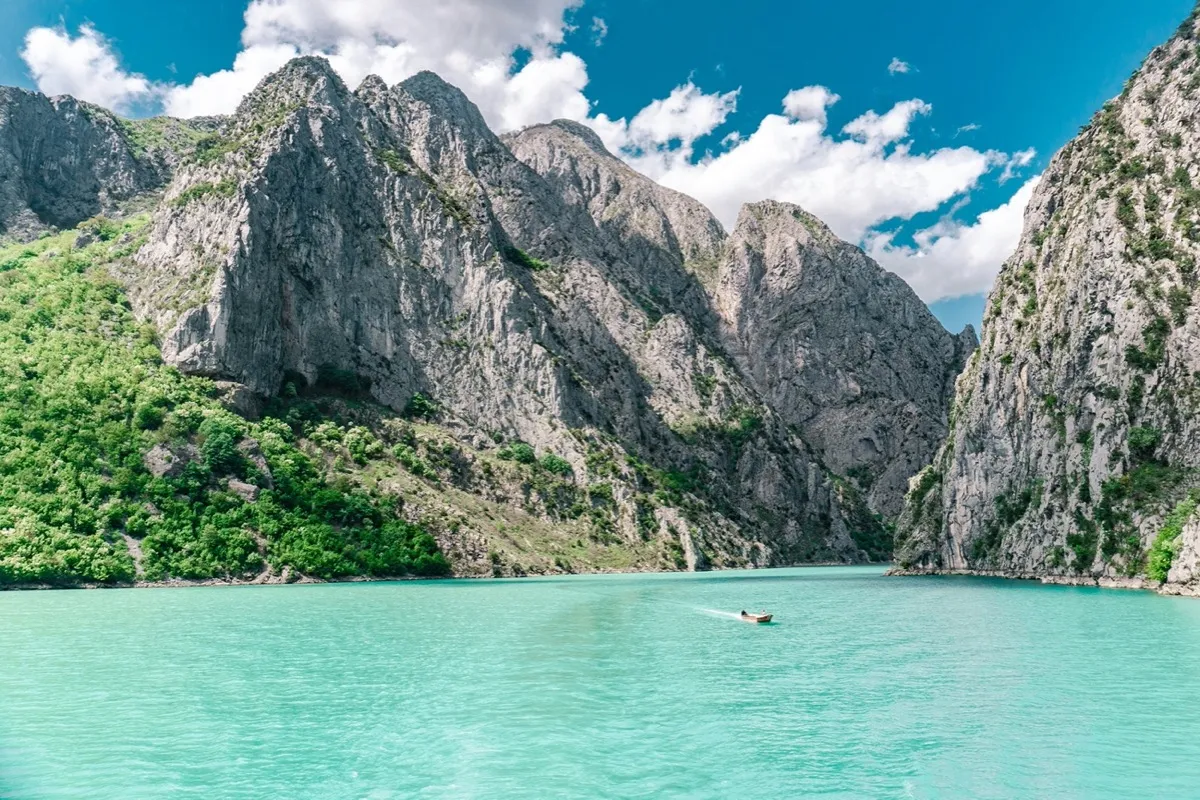
Two hours north of the beach, the "Accursed Mountains" — Bjeshkët e Nemuna — rise green and jagged above villages of stone. Shkodër is the gateway: Albania's cycling city, with the Rozafa castle above a lake whose sunsets look painted. From there a winding road climbs to Theth, a single-street village in a bowl of mountains where every house has a guesthouse and every guesthouse has byrek for breakfast.
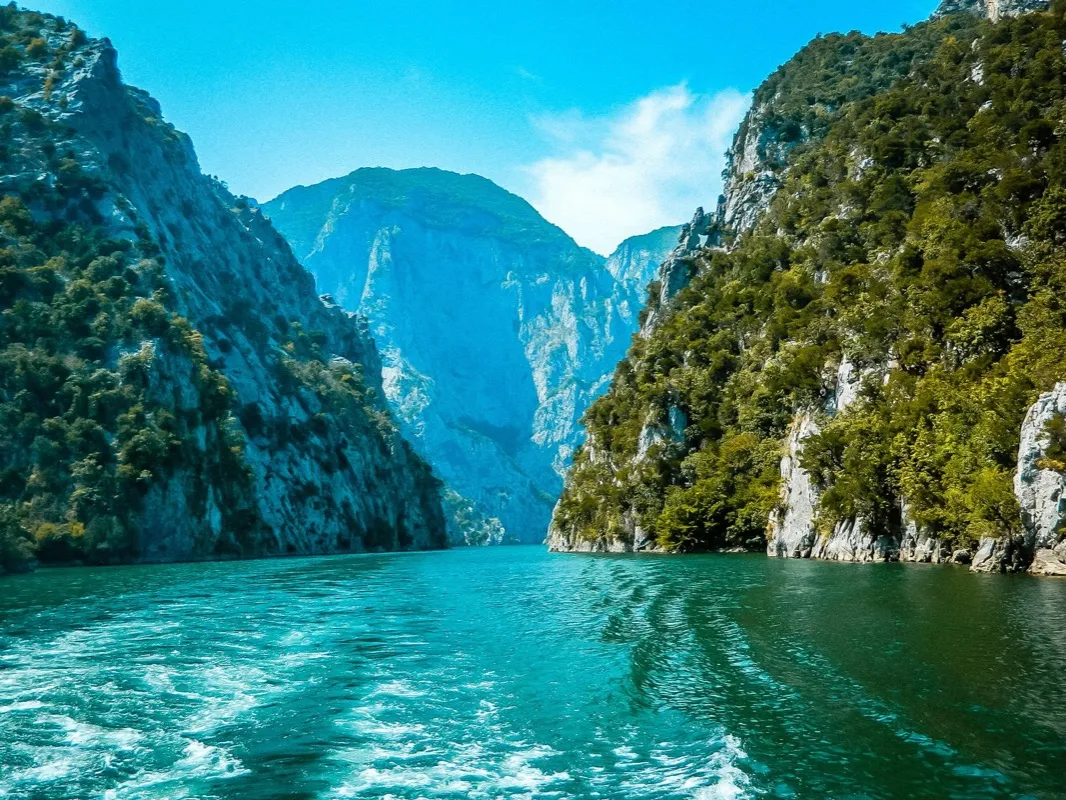
The signature walk is the Theth–Valbona pass — six to eight hours over a 1,800-metre saddle through alpine meadows and waterfalls. Most visitors hike one way and arrange a ferry+vehicle transfer to retrieve the car, because the Theth and Valbona valleys are separated by mountains, not roads. The Lake Koman ferry is the other half of the trick: a fjord-like boat ride through sheer gorges, quietly one of Europe's great rides.
A 2WD rental is fine for the road to Theth in summer, but it is narrow, unsealed in places, and the last 30 km feel longer than they look. Fill up in Shkodër; petrol is sparse beyond. If the Alps detour does not fit your dates, do at least the Lake Koman ferry as a day trip from Shkodër — it is the single most photogenic three hours in the country.
Castles in the Clouds — Inland and North
Two UNESCO sites anchor the inland route: Berat, with tiers of white Ottoman houses and a hilltop castle that is still a living neighbourhood; and Gjirokastër, the "stone city" of slate roofs, cobbled lanes and one of the Balkans' largest fortresses. Berat is a day, Gjirokastër is a day, and both are worth lingering for an evening because they look different by lamplight.
Krujë sits an hour north of Tirana — Skanderbeg's mountain stronghold, with a romantic old bazaar perfect for souvenirs, copper and silver. North again, Shkodër is the gateway to the Alps but also a serious destination on its own: cafés, a museum or two, the lake, and that castle. From Shkodër you can either continue into the Alps or close the loop south to Tirana through the wine country around Lezhë.
Add Apollonia on the return run if you have time — a quiet, mostly empty archaeological site outside Fier where you can walk among ruins without queues. Durrës has the longest beach in the country and a 2nd-century Roman amphitheatre under the modern city; an espresso on the waterfront makes a good final stop before the airport drop.
What to Eat, and Where
The dishes to hunt down: tavë kosi, baked lamb and yogurt — the national dish and the one most often perfect; byrek, flaky savoury pie sold by the slice; fërgesë, a slow-cooked tomato and curd-cheese stew with peppers; qofte, grilled meatballs; seafood straight off the Ionian; speca të mbushur, stuffed peppers; petulla, fried dough with honey; baklava with a glass of raki to finish.
A few tables we like, by region. In Tirana: Mullixhiu for modern, farm-to-table Albanian; Oda for homestyle dishes in a cosy courtyard; Era for reliable Balkan classics in Blloku. In Berat: Homemade Food Lili, a family table in the old town — call ahead, it is worth it. On the coast: the seafront fish tavernas in Ksamil and Sarandë — point at what looks freshest. At Llogara: roadside lamb spits at the top of the pass, where the view is the side dish.
Tables and hours shift with the season — a quick call or message ahead never hurts. In the mountains, the best meal is often the dinner your guesthouse cooks for you. Tip in cash if you can, round up rather than calculating, and remember that "një kafe" is rarely just a coffee in this country — it is an invitation to sit for an hour.
Driving in Albania — the short briefing
You drive on the right; belts on; lights as required; don't drink and drive, because checks are frequent and serious. Main routes (the SH network) are modern and smooth. Mountain roads to Theth, Llogara and the Alps are narrow and winding — slow down, enjoy them, and yield to anyone coming downhill.
Stations ("karburant") line the main roads but thin out in the mountains; fill up before Theth, Valbona or a long coastal day. The A1 "Nation's Highway" has a toll near the Kalimash tunnel on the way to Kosovo — keep some cash handy. On rural roads expect livestock, slow tractors and the odd pothole; keep your distance and your patience.
Parking is tight in central Tirana and on the Riviera in July–August. Arrive early and ask your host where to leave the car. Google Maps is reliable for navigation; download offline maps for the Alps, where signal disappears. Keep your driving licence, passport and our rental documents in the car. Any trouble at all, call 112 — and call us. We answer.
Your keys to Albania
Pickups are easy from Tirana city and Rinas Airport (TIA), and the country is small enough that the whole map is genuinely a day trip from the capital. For the south, you can pick up coastal (Sarandë or Vlorë) and save half a driving day. For the Alps, start in Shkodër and you are at the trailheads in two hours.
Booked the car? Then the whole country is yours. Download the PDF of this guide for offline reading, pin the spots in your maps app, and go slowly — the best moments are the ones you didn't plan.
Frequently asked questions
When is the best time for an Albania road trip?
+
May–June and September–October are the sweet spot: warm water, dry roads, no crowds. July and August are gorgeous but very busy on the Riviera — book your car well in advance. The Alps are best between mid-June and mid-October; outside that window the Theth road can be impassable.
Do I need a 4×4 to drive in Albania?
+
No. A 2WD car covers everything in this itinerary, including the Llogara Pass and the standard road to Theth in summer. Choose an SUV or higher-clearance car if you plan to push deeper into the Alps (Valbona valley side roads) or visit outside the main season.
Is driving in Albania safe?
+
Main roads are modern and well-maintained; the SH8 along the Riviera is excellent. Mountain roads are narrow and require patience. Watch for livestock and slow tractors on rural routes, and don't drink and drive — police checks are common and the limit is low.
Can I take my rental car into Kosovo or Montenegro?
+
In some cases yes, with advance notice — we add cross-border insurance and provide a green card. Tell us your plan when you book so we can prepare the paperwork. Driving into Greece is also possible.
Are tolls common?
+
No. The only one most travellers encounter is on the A1 "Nation's Highway" near the Kalimash tunnel on the way to Kosovo. Keep a few hundred lek in cash for it.
What documents do I need to rent and drive?
+
A valid driving licence (EU, US, UK or international permit), your passport, and a credit card for the deposit. We handle everything else — insurance, paperwork, 24/7 phone support on the road.
Browse rental cars
Your keys to the Adriatic & Ionian — turquoise bays, stone cities and mountain passes, all within a single tank of fuel.